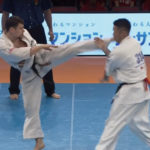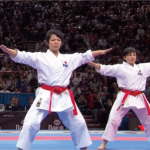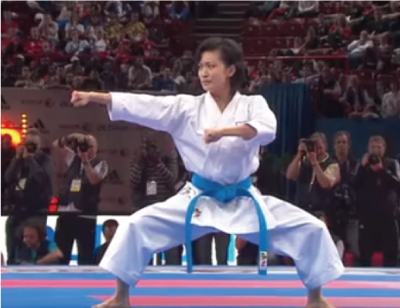
空手歴23年、空手を愛する筆者が未経験の人でも分かるように空手を徹底解説!

Karate

知名度が高い格闘技「空手」、
皆さんご存知のように、
2020年の東京オリンピックからは空手が正式種目になりました。

オリンピック出場を目指すぞ!

テレビのCMで見る空手美人みたいに、カッコよく形(かた)をやりたい!

空手を習って純粋に強くなりたい!

など、いろんな角度から興味がわくと思います。

しかし、空手には多くの流派があり、ルールもよく知らなければ、

結局のところ、
「興味はあるけどよくわからない!」と感じる人も多いはず。

日本の伝統武道なのに、わからないのはちょっともったいないと思いませんか?

日本勢には、金メダルの有力候補が何人もいます。
空手について詳しく知っていた方が、

絶対にオリンピックを楽しめます。

そこで、空手歴23年の筆者が、「空手の流派」について、未経験の人でも分かるように丁寧に説明したいと思います。

この記事を読めば、
空手の流派の違いから、
オリンピックの空手に関すること
そして空手の極意を奥の奥まで知ることができます!

空手とはそもそもどういうものなのか?
テレビで見る空手はどんな空手なのか?
試合はどんなルールなのか?
どの流派の空手を習った方がいいのか?

が詳しく分かるようになり、さらに空手に接することが楽しくなるのです??

目次

What Is "Karate" in the First Place?

Karate is formally known as Karate-do,
and involves using fists, elbows, knees, and feet, primarily strikes .

The origins of karate lie in a Ryukyuan martial art called “Te” (Tee), which dates back to around the 15th century.
From there, the name evolved from “Tōde” → “Karate” → “Karate-dō.”

また、テレビで空手を見かけることも、最近では増えたように思います。

K―1で有名な「極真空手」

オリンピック種目の「スポーツ空手」

形(かた)をする「カッコイイ空手」

ルールの違い、流派の違い、いろいろありますが、それらの違いを無視して、全部ひっくるめて空手、と呼ばれていますね。

現在では、空手道が、2つに大きく分かれています。
空手を分ける一番大きな分類は、技の違いよりも、

「どうやって競うか?」

つまり、
試合のルールで区分けできます。
試合のルールで大きく分けると、

「伝統空手」・・・試合では攻撃を相手に当てない「寸止めルール」。伝統的な形(かた)と組手。
「実戦空手」・・・試合で攻撃を相手に当ててKOする

The Olympic discipline is "Traditional Karate."
This Traditional Karate is also divided into major styles.

There are different styles within “practical karate” as well.
However, in terms of philosophy,

Karate → Traditional karate or practical karate? → If it's traditional karate, which style is it, and,

When we say “karate styles,” we are referring specifically to “traditional karate styles.”

伝統空手

オリンピックの空手は「寸止めルール」の伝統空手というジャンルに区分されます。

この伝統空手は、
・組手(1対1で攻防戦を繰り広げる)
・形(一人で技を繰り広げてその技の精度、力強さ、美しさを競う)があります。

(注)瓦は割りません??

筆者自身、空手を始めて23年間、割ったことありませんし、試し割りを見たこともありません。

組手
おおまかなルール

組手は、1対1で突きと蹴り等を使って攻防戦を繰り広げます。
KOするのではなく、技を決めてポイントで競う競技です。

「寸止めルール」で、
「きれいに決まった攻撃」にポイントが与えられます。

つまり当てたら反則。

ポイントに関しては、おおまかに次のとおり
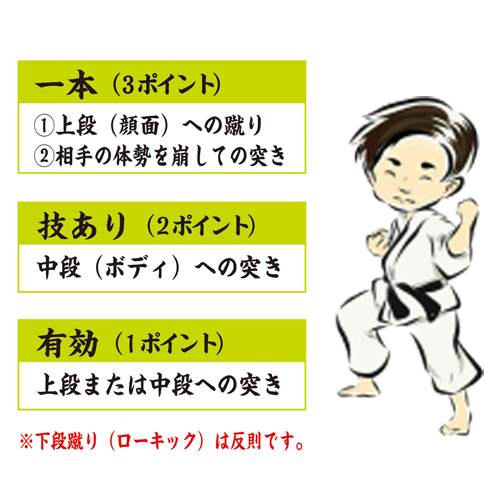
空手 ポイント
「きれいに決まった攻撃」にポイントが入る
こう聞くと、武道と言うにはあまりに大人しそうで、
もの足りないようにも聞こえるかもしれません。

しかし、空手道における「きれい」とはつまり、

「空手の基本に忠実な攻撃」

突きでいうと、
「全体重が拳に乗った」攻撃です。

「もしこのまま寸止めせずに当てていれば、一撃必殺もしくは大ダメージを与えていただろう」という攻撃に、ポイントが与えられるのです。

「寸止めルール」でも激しい!

「寸止めだから安全だね」とか、「痛くないんでしょ?」
「やっぱり空手はガチで戦うフルコンタクトだよね」とか聞きますが、

伝統空手の組手だって、攻撃が当たってしまえば
ダメージは大きく、とても激しいものです。

空手は武道である以上、
生半可な競技ではありません??

攻撃が当たってしまうと、
失神することも珍しくありません。

防具をつけていても、
油断していると歯が折れることもあります。

多くはないですが、
アゴを骨折する人もいます。

ポイントになる攻撃=もし当たっていれば大ダメージになった攻撃=全体重が乗った攻撃

これが当たってしまえば、
もちろん大ダメージになるのです。

当たったら反則ですので、
コントロールも不可欠です。

(不思議なことに、「寸止めルール」なのですが、ボディにはガンガン当てても反則を取られることはほとんどありません。暗黙のルールですね・・・・。でも、明らかにダウンさせようとして殴り切るよう突きは、もちろん反則を取られます。)

礼を重んじる!

「礼に始まり、礼に終わる。」
空手が競技化した現在も、これはルールとして決められています。

礼をしなければ
指導を受け、場合によっては反則になります。

ガッツポーズも禁止です。
(見逃されることもありますが・・・)

私の後輩が、上段回し蹴りで3ポイントで大逆転を遂げ、思わずガッツポーズ!!
即座にポイント取り消しになったことがありました・・・・

ガッツポーズも無しなんて辛気臭いなあ・・・
喜びを表現するくらいいいだろうに・・・
と思う方もおられるかもしれません。

色々な考え方がありますが、

空手道という武道においては、
争いに勝つ事よりも、空手道を通じて人格形成が重要な目的。

相手も必死で稽古をして、闘いに臨んでおり、自分も必死の稽古の結果をぶつけた。

自分が勝ったとしても、時の運かもしれない。
自分が優れていると勝ち誇るために稽古をしてきたわけでもない。
相手の研鑽を尊重し、素晴らしい勝負をしてくれた相手に感謝する。

そこにきて、

自分を誇ると思われる可能性のあるガッツポーズ等の挙動をすることは、
「相手への尊敬の念、配慮が足りないとみなされる」
ということです。

伝統空手の組手はスピードと、何より駆け引き!

伝統空手の組手の特徴は、

「駆け引き」と「速さ」です。

この速い攻撃も、手だけでシャッ!と撃つパンチは、ポイントになりません。

全体重が乗った突きをボクシングのジャブクラスのスピードで撃つ。
同じように蹴りもめちゃくちゃ速いし、全体重が乗っているので重いです。

これは、筆者が好きな西村拳選手の組手↓

こんなに素早くて腰が入った攻撃が当たったら、そりゃ大ダメージです。

組手では、攻撃の速さ、踏み込みの速さ、それだけでは勝てません。
なによりも、駆け引き。

これも一流選手同士の組手です。

すごい・・・・

この2人とは、絶対あたりたくないです・・・

※タイトルで「永木伸児vs松久功」となっていますが、松久選手ではなく、樋口大樹選手ですね

また、

このように、めちゃくちゃ速い空手の突きですので、
相手の間合で撃たれたら、

まずよけられません。

だから、相手の間合いにさせず
かつ、自分の間合いにもっていく。

そのために、

「せめぎ合って間合いをはかる!」

「フェイントで相手の体制を崩す。」

「ふと間合いを切ったと思いきや瞬時に詰めて意表をついて自分の間合いにする。」

すると、

感覚的に分かるんです。
今だ!!行ける!!という瞬間が!

この瞬間を逃さず攻撃をしかけると、
気持ちよくスパーン!!と
会心の一撃が決まります!

これはもう感覚です。
距離が遠い近いだけでは到底はかり切れません。

例えば、同じ位置関係でも、

相手が前の足に体重がかかっている場合と、
後ろの足に体重がかかっている場合では、
対峙する相手の印象は全然違います。

相手が後ろに体重がかかっている状態(気持ち的にでものけぞったような状態)だと、
非常に攻めやすく、相手は防ぎにくい。

逆に、

相手が中心に体重をかけている状態だと、なかなか攻めにくい。

無理に攻めると「死んだ攻撃」になってしまい、カウンターを食らってしまいます。

自分が攻撃しやすく、相手が防ぎにくい・反撃しにくい状態を作るための駆け引き。

この駆け引きが空手をしていて
一番面白く、また、難しいところです。

観戦していても、ポイントになる攻撃は、
キレイに決まった攻撃じゃないとポイントにならないので

決まった突き、蹴りを見ると、気持ちがいい!

せめぎ合って、仕掛けるか仕掛けないかの駆け引きの後、
一瞬ですべてがぶつかり合い、決まる技。

おすすめの選手の組手

おすすめは、
オリンピックの組手競技優勝候補
荒賀龍太郎選手の組手です!

ズバ抜けた組手センスと圧倒的な練習量を誇る空手エリート達の中でさえ、
さらにズバ抜けたセンスと実力を持つ天才選手です!

この動画の荒賀選手にやられた選手達でさえ、
スター軍団だの、モンスターだのと言われた猛者達。

それを涼しい顔(のように見える)でキレイに大技を決める!

ひとつひとつの動きが 神業です・・・

オリンピックでも金メダルが期待されます!

そして、

学生日本一近大の西村拳選手!

スマートな容姿、しかし熱い組手、カッコイイ!!↓(さっきと同じ動画ですが、スルーした方のためにもう一度 笑)

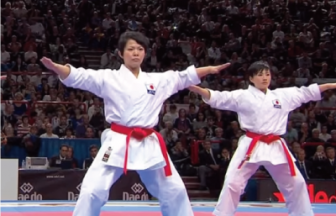
形は、誤解を恐れずに簡単にいうと、伝統的な空手の技をテンプレート化した、一続きのダンスのようなものです。

1対多数を想定し、ありとあらゆる攻撃に対する防御、そこからのありとあらゆる反撃が組み込まれています。

形をすることを、「演武」と言いますが、相手がいることを想定して「演じ」、戦う(「武」)ことから、そのように言われます。

もちろん、踊りではないですから、実際に相手の攻撃を受けられる動き、
相手を一撃で倒せるような攻撃(全体重を乗せた攻撃)でなければなりません。

そのような動きを、
美しく、力強く極めて演武をする。

これがいかにできているかを競うのが、
空手の「形」競技です。

形の審査基準

これには、細かい審査基準が設けられています。

たとえば、

・カカトが地面にしっかりついているか、
・手やヒジの角度は定められた形通りの角度になっているか、
・視線は想定した相手に向けられているか、
・ワキが空いていないか、
・腰は落ちているか、
・体重移動はスムーズか、
・形が終わった後で元の場所に戻ってきているか、等々。

これらの基準を守りつつ、空手の理想の攻撃ができているか、
美しさ、力強さ、気迫があるかを競います。

The Origins of Each School (The Four Major Schools)

Karate, a martial art that primarily uses the hands and feet to deliver strikes.

The great masters of that era, as if captivated by the allure of the martial arts, devoted their lives to relentless training, adding their own unique twists to systematically refine and perfect these arts.

That eventually became established as a "school."

現在では、大きく分けて、4つの流派があります。
剛柔流、糸東流、松濤館流、和道流です。
(ほかにも数えきれないほどの多くの流派、文派があります)。

The characteristics of a style are reflected in its forms.

In Olympic kumite, which follows the “stop-short rule,” the characteristics of specific styles generally do not stand out prominently.

When watching kumite matches,
people often say things like, “Those footwork combinations look just like the style from XX High School,”
“As expected of XX University—their kumite is so grounded, they don’t back down an inch!” or
“The fighters from XX Dojo are really good at reading their opponents!”

However, no one thinks to themselves, “This is Shito-ryu kumite!” or “This is Goju-ryu kumite!”

したがって、
どの流派が最強か?という答えは、

やはり
個人の選手の実力による
という月並みな答えしか出て来ません・・・・・

(That said, since the Shōtōkan-ryū style alone held matches within the school that were single-point bouts fought bare-handed without protective gear—matches that could easily result in serious injury if even a single mistake were made—I do sometimes get the impression that kumite under the All Japan Karate-do Federation (which follows rules nearly identical to those of the Olympics) is also quite intense.)

The differences between styles lie mainly in the forms.

The forms are condensed versions of each school’s techniques, distilled into standardized templates. That is precisely why the differences between the schools are so clearly evident.

There is a competition focused on kata, and this is the cool karate that became a hot topic in TV commercials and promotional videos. Every style of karate has its own kata.

Goju-ryu

There are two types of traditional karate.
“Shurite”: Characterized by fast, linear movements
“Nahate”: Characterized by slow, powerful movements with many curved motions and a tenacious style

Although this distinction is not evident in modern kumite, this type of kata—which possesses characteristics intermediate between Shuri-te and Naha-te—
is classified as Tomari-te.

The Goju-ryu is the most representative style of Naha-te.

Founder of the Goju-ryu Style

The founder of the school is Master Chojun Miyagi.

Born during the Meiji era, he began training under Master Higa Onna Kanryo, a master of Naha-te, and also devoted himself to the practice of Chinese martial arts, thoroughly studying both the techniques and the underlying theory.

Characteristics of the Goju-ryu Style

A distinctive feature of the Goju-ryu style is its footwork, which incorporates the rowing posture of ethnic groups in southern China.
Because southern China has many rivers, boats were a popular means of transportation.

Therefore, the people of the South were accustomed to living on boats, where their footing was always unstable.

When Master Miyagi traveled to China to study Chinese martial arts, he noticed that the people of this southern region rarely lifted the soles of their feet off the ground as they moved; instead, they seemed to propel themselves forward by pushing off the floor with their feet.

This way of standing and moving, as if the feet were firmly rooted to the bottom of a boat.
Taking inspiration from this,
it is said that this stance gave rise to the “Sanchin-dachi” stance.

This stance and these movements are extremely difficult!

Unless you’re a true genius or someone who practices karate around the clock,
you won’t be able to do it in just a year or two.
It took me
four to five years to get to a decent level .

A key feature of this training method is the circular movement created by “hooking” the opponent’s attacking arm to entangle it.
This allows you to control the opponent’s movement, deflect their attack while minimizing the impact, and transition into a counterattack from within their motion.

The goal is to use this to confuse and manipulate the opponent, and ultimately to control their consciousness.

"Controlling one's consciousness? Like that's even possible."

Some of you may be thinking that.

However, when your attacks are skillfully parried by your opponent and you find yourself at their mercy, you enter a mental state where it feels as if even your own consciousness is in their hands, and it becomes a struggle just to maintain your fighting spirit.

In technical terms, "applying and releasing force" , “reverse utilization of force” , “perceiving the flow of ki” .

The philosophy of Goju-ryu is as follows:
・All phenomena consist of “Go” and “Ju.”
・Go represents offense, and Ju represents defense.
・The unification of Go and Ju leads to a state of mind free from ego, which avoids conflict.
These are our goals.

Martial arts are only possible through mental discipline

As a lesson from Founder Miyagi:
“Do not strike others, nor be struck by others; seek to avoid conflict.”
This philosophy of safety encapsulates the ideals of the Goju-ryu style.

What a wonderful philosophy—one that aims not to defeat or harm the opponent, but to avoid and resolve conflict!

Shito-ryu

Shito-ryu is a style of karate that incorporates both Shuri-te and Naha-te.
Furthermore, it is characterized as a comprehensive martial art thatincorporates techniques from Ryukyu’s traditional martial arts, such as bojutsu (staff techniques) and saijutsu (sword techniques).

Founder of the Shito-ryu Style

The founder, Master Kenwa Mabuni, studied the Itosu-ryu style under Master Ankō Itosu, a master of Shuri-te karate.

Then, through an introduction by Master Chojun Miyagi—who would later become the founder of Goju-ryu—I studied the Higaonna style under Master Kanryo Higaonna, a master of Naha-te.

Master Mabuni also incorporates various other forms of karate and martial arts.

Even after graduating from junior high school and becoming a police officer, he continued to explore kata and techniques other than Shuri-te and Naha-te.
He trained in various karate styles, including the Matsumura and Aragaki schools.

In addition to karate, there are the Ryukyu traditional martial arts of bojutsu (staff techniques) and saijutsu (sword techniques).
Shito-ryu Karate-do is the result of the fusion and harmonization of all these techniques and spiritual principles.

As you can see, the name “Shito-ryu” is derived from the initials of Masters Itosu and Higashionna.

Characteristics of Shito-ryu

In terms of technique, it is a comprehensive martial art that includes not only strikes and kicks but also throws and joint locks.

Furthermore, as exemplified by the phrase “Shu-Ha-Ri” (which describes the master-disciple relationship in martial arts, the tea ceremony, and other disciplines—first adhering faithfully to the basics, then analyzing, refining, and applying them, and finally breaking away from them to reach a new level of mastery),

Master the fundamentals of form → Apply them to kumite → And master even the deepest secrets of the art.
This process has been systematized, and instruction is based on it.

The Shito-ryu style is, above all, a wide variety of techniques , so
there are an incredible number of kata.
After years of repetitive practice, no matter how many kata there are, your body just remembers them on its own, but...

There are also forms for staff techniques and hairpin techniques (saijutsu).
This is the Shito-ryu form, “Chatan Yaraku Sankū.”
It’s long, and it’s really tiring for the performer, but it’s a very impressive form.

"Chatan" by Rika Usami, the beautiful karateka.

One of the defining characteristics of Shuri-te is its speed.
As an aside, I personally find the audience applause during the double-kick sequence a bit distracting.

It’s something unique to international tournaments, but the rhythmic, electrifying atmosphere kind of throws me off my game...

Mental Training: The Fist of the Noble Man

Rather than the technical aspects of karate, its essence lies in mental discipline.

開祖摩文仁賢和師は「君子の拳」(くんしのけん)を標榜し、「円満な人格の形成・向上」を目指した指導を行いました。

Here, too, we can see the spirit of a “harmonious character”—that is, one who does not choose conflict but aims to avoid and resolve it—which is a wonderful ideal for the human way of life.

Shōtōkan-ryū
Founder of the Shōtōkan-ryū Style

The founder of the Shōtōkan-ryū style is Master Gichin Funakoshi.
He is said to be .

The name of the school was not chosen by the master himself.

Since Master Funakoshi, who was also a calligrapher, used the artistic name “Shōtō,” and because this name conveys the meaning of being as dignified as a pine tree and as powerful as a raging wave, the school later came to be known as the “Shōtō-kan” school.

It was Master Funakoshi whorenamed “Karate” to “Karate” and also changed “Karate-jutsu” to “Karate-do.”

Characteristics of the Shōtōkan Style

The traditional practice of the Shōtōkan-ryū style is to place great emphasis on “kata” training, in accordance with Master Funakoshi’s final teachings: “Be faithful to the kata; there are no matches in karate.”

Even in the pure Shoto-kan style, we practice kumite while respecting our opponent. However, this is not a contest.
It is a way to verify whether the defensive and offensive techniques used in kata have been trained to the point where they can be effectively applied in real situations.

Shōtōkan-ryū Karate is a martial art that anyone can start at any time, regardless of age, gender, personality, or physical build. It is designed to be practiced without strain, and places equal emphasis on physical fitness as well as martial arts training.

Shoto-kan has a dynamic design!

When viewed in the context of the Shōtōkan-ryū form, each technique is extremely dynamic !
The lunges during attacks are also much larger compared to other schools, making them incredibly powerful!

Thud!!! on the floor There are also moves where they stomp like that.
The movements are huge!

If you perform such a large movement in a kata competition of another style, you’ll lose points (though this depends on the style...).

The Shoto-kan-ryu kata is, to put it simply, truly awe-inspiring.

It is said that the reason this technique became so dynamic is that it was designed with the scenario in mind where a smaller person would face off against a larger opponent.

So, since your opponent is considerably larger than you, your defensive movements and lunges naturally become more exaggerated, right?

This is the group kata "Unsu" from Shoto-kan.
So powerful!!

The "decomposition kumite" demonstration that followed the kata was also fantastic!

Bukai Kumite recreates the scenarios embodied in the kata:
"When an opponent attacks from here like this, I’ll defend like this and counterattack like this"
It’s world-class quality!!

Mental Preparation

The Shōtōkan-ryū school also does not believe that training in techniques alone is sufficient.

Master Funakoshi completed the “Twenty Precepts of Karate-do, which include the principle that “there is no first move in karate, and
presented them as guidelines for those studying karate-do and as life lessons for karate practitioners.

The Shōtōkan-ryū defines karate-do as
"not only a path to spiritual cultivation, but also a form of physical education, a method for maintaining health, and a self-defense art that anyone can practice and continue for a long time, even without physical strength. "

Wadō-ryū
Founder of the Wadō-ryū School

The founder of the Wadō-ryū style is Master Hiroki Otsuka.

Wadoryu is a style of karate that originated in Okinawa and was adapted to fit Japanese martial arts traditions, a Japanese adaptation of karate .

Master Otsuka studied under numerous masters and founders of various schools, and through this, he perfected the Wadō-ryū.

First,
He received instruction from a former martial arts instructor of the Tsuchiura Domain,
and studied under Master Tatsuzaburō Yukiyoshi Nakayama, the third-generation head of Shintō Yōshin-ryū Jujutsu (achieving full mastery), and succeeded him as the fourth-generation head of Shintō Yōshin-ryū.

He also studied karate under the guidance of Master Yoshichika Funakoshi of the Shōtōkan-ryū style (
),
and through technical exchanges with Master Asaki Honbu of Nihon Denshū Heihō Honbu Kenpō and Master Kenwa Mabuni of the Shitō-ryū style.

Not only that, but
we also incorporated elements of swordsmanship and jujutsu, such as the body movements used in the Yagyu Shinkage-ryu and Tomita-ryu kodachi styles.

He seems to have been quite the martial arts scholar...
I wonder just how passionate he was about martial arts research...

The culmination of all this is Wadoryu Karate.

Characteristics of the Wadō-ryū Style

As mentioned above, the Wadoryu style incorporates all forms of Japanese martial arts including swordsmanship, jujutsu, and other Japanese martial arts into karate and is therefore considered a “Japanese-style” form of karate.

The techniques in Wadoryu kata are more similar to those of Shōtōkan-ryū than to those of Gojūryū or Shitōryū.

At tournaments (such as the All-Japan Karate-do Federation Championships) where all four major styles and others come together and are held under the same rules as the Olympics, I get the impression that it’s relatively rare to see Wadoryu kata.

In addition, since it incorporates jiu-jitsu, it features a wide variety of throws and leg techniques.

Furthermore, perhaps as a result of his study of all kinds of martial arts, including swordsmanship, his movements seem refined and free of unnecessary motions.

The Essence of the Wadō-ryū

A poem by Master Otsuka, the founder of the style: “Do not think the Way of Martial Arts is merely about violence; rather, pursue the Way of Harmony and seek harmony.”

The Wadō-ryū style is based on the principles of “respect, love, and courtesy (rei),” and its goal is to seek “harmony,” which is more difficult to achieve than conflict.

It’s often said that seeking harmony is more difficult than fighting and defeating an opponent.
The essence lies not in defeating one’s opponent, but in pursuing the path of harmony.

Which style should I choose?

The way karate is practiced varies greatly from one dojo to another.

Which school you choose depends on
depends on what you want to do.

90% of the practice is kumite! There are dojos like that, and
90% is kata!
This isn’t a difference in styles, but a difference in dojo policies.

I want to get in shape!

When choosing a style, the one factor that definitely makes a difference is “which kata you perform.”

So, try looking it up in a video:
"I want to practice Shito-ryu kata!"

そう思ったら糸東流の門をたたいてください。
そうすれば、糸東流の形を教えてもらえることは確実です。

It’s hard to say exactly which dojo you should choose without actually visiting it yourself, though...

組手をしたい!

I'm not interested in the form, so
"Just let's spar!"

という方は、近くの道場に足を運んで練習風景を見て、組手の練習が行われているかを確認するのが一番でしょう。

If you look at it, you can get a general idea of the ratio between kata and kumite.

You'll know right away if the atmosphere suits you and if it has what you're looking for!

I want to compete in national-level kata and kumite!

Whether it's kata or kumite,
"I want to give it my all and aim for the national championships!"

If that sounds like you,

各流派の公式ホームページの大会記録の都道府県大会の成績上位者の出身道場の門をたたくのもいいでしょう。

Reference sites below:
Gōjūkai↓
https://www.karatedo.co.jp/gojukai/

糸東会↓
https://www.karatedo.co.jp/shitokai/

Japan Karate Association (Shōtōkan-ryū) ↓
https://www.jka.or.jp/local/

和道会↓
https://www.karatedo.co.jp/wado/

The Spirit of Karate-do

Under Master Funakoshi, "karate" was renamed "karatedo."

Not martial arts as a combat technique, but "Budo"—a way of life centered on the theme of combat—
In other words, the true purpose is not to pursue the ultimate efficiency of attack and defense.

It is merely a means to an end—the ultimate goal being to resolve the dispute.

As we have seen, any form of karate—as long as it is “Karate-do”—embodies the ideals of the human way that we should strive to pursue.
Even if one devotes oneself solely to becoming stronger than others, neglecting the discipline of the mind and spirit can lead to violence.

This is the spirit and mindset necessary to live a meaningful life, even in today’s society, where there is less need for hand-to-hand combat or other situations in which karate would be directly useful.

Allowing an immature first-grader to carry a Japanese sword does more harm than good.

同じように、
戦いの技を持たせるに値する心・精神も、技と同時に磨いていかなければ、
空手という武術の存在意義など、無に等しいのです。

We practice karate as a tool for learning the way of humanity and living our lives with integrity.
Through diligence, unwavering effort, and respect for our opponents, we cultivate humility—never forgetting to bow in respect, whether we win or lose.
It is our belief that only such individuals are truly worthy of pursuing the art of karate.
Karate is not meant to injure or defeat an opponent.

"Kata," which incorporate the fundamentals of karate as a template, always begin with a defensive stance.
"There is no first strike in karate."
Striking first is an act that provokes a conflict.

This is because the premise is that you do not actively harm your opponent, but rather, after being attacked,
you fight your opponent to defend yourself
.

The Future of Karate

Karate, now an Olympic sport, is likely to continue to grow in the future.

However, if we were to turn this into a sport where attacking and defending are merely tools for scoring points,
it would be far too dull and a real waste.

After all, in every aspect of competitive karate, it’s commonplace to see elements that have no direct bearing on the superiority or inferiority of a technique,

Why have things like “etiquette” and “the prohibition of victory poses and provocative behavior” been codified as rules?
I believe that only by understanding the spirit behind these rules can one truly walk the “Way” of karate.

Thank you so much for reading this far!
Please take a look at karate—even if it’s just through a video—and listen to the sounds of it!

And if you ever feel like giving it a try, be sure to stop by a dojo near you!
Just like me, you might find yourself surrounded by friends who are like family, all united by the spirit of martial arts!

関連記事

  1. Karate

    「帯」なんて関係ない?空手教室選びにあたって押さえておくべき点を3点に絞って解説!

  2. Karate

    空手上達への近道は基本だった?初心者も有段者もしっかり行うべき理由!

  3. Karate

    これから空手を習う人のために、教室選びの前に空手の流派について詳しく丁寧に説明

  4. Karate

    「空手」を習う前に知っておくといい基礎知識。得意、不得意、怪我の有無、正確な知識を徹底解説!

  5. 空手道場の選び方とは? 年間の試合数が大切になる理由とは?

  6. Full-Contact Karate

    「フルコンタクト空手」ってどんなもの?発祥から大会ルール・勝つための稽古方法まで詳しく解説します